

The opioid epidemic has seen the over-prescription of opioids as painkillers. An estimated 645,000 people died from opioid use between 1999 to 2021 in the U.S. alone, with the figure running into millions worldwide.
Why was something prescribed which is so clearly addictive? Because it wasn’t clearly addictive. Indeed, an article published in the prestigious New England Journal of Medicine, entitled “Addiction rare in patients treated with narcotics”, claimed to find the opposite.

The article has been cited 1,676 times, and widely used as evidence that opioids aren’t addictive. For example, a 1992 TIME article entitled “Less Pain, More Gain“, states the following:
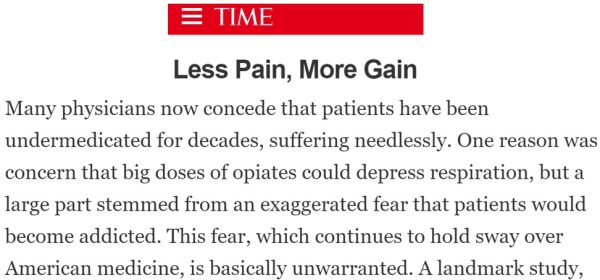
It argues that patients have been “suffering needlessly” due to an “exaggerated fear that patients would become addicted” what is “basically unwarranted”. It goes onto reference the “landmark study” in the New England Journal of Medicine.
So let’s look at the study. Here’s the first page:

But where’s the second page, or the tables with the results? In fact, there are no more pages. This is the entire study – and it’s not even a study, but a five-sentence letter to the editor. Indeed, the full letter is here:
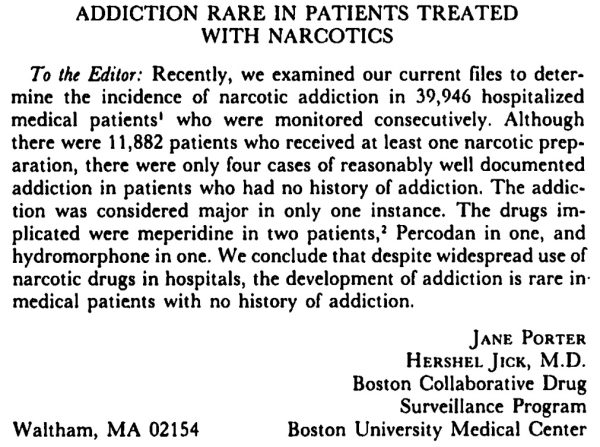
That’s it. It takes up just one-sixth of a page in the journal. This is an example of the first misstep up the Ladder of Misinference: a statement is not fact, because it may not be accurate. It highlights how misinformation is far more than just “fake news”, and combatting it goes beyond just checking statements. There was indeed an article entitled “Addiction Rare in Patients Treated With Narcotics” in the New England Journal of Medicine, so anyone claiming this is – strictly speaking – not spreading fake news. But it’s misleading without the context. Many people may have cited this article reading no further than the title – not realising it’s simply a letter that hasn’t been checked, vetted, or peer-reviewed by anyone.
And even if the letter is 100% accurate, it’s still misleading. The letter does contain two footnotes which reference academic research (“Comprehensive Drug Surveillance” and “Clinical Effects of Meperidine in Hospitalized Medical Patients“), which are far less cited, potentially because people would have to read beyond the title to see what they’re about. Let’s assume that these papers are 100% accurate. They study patients who received “at least one” narcotic preparation. Even if one dose of narcotics doesn’t lead to addition, two or three might. They also study “hospitalized” patients. In hospital, when narcotics are administered on a controlled basis, patients may not get addicted, but those prescribed opioids as an outpatient may well do. Again, checking the facts is not enough. Even if those studies are fully accurate, the inferences we draw from them can be misleading.
We like to cite bold claims without checking the evidence or context behind it. Peter Drucker never said “Culture eats strategy for breakfast”, and even if he did, this claim is unreliable without research across hundreds of companies studying the relevance importance of culture (controlling for strategy and other variables) and strategy. Milton Friedman did write “The social responsibility of business without increasing its profits” but, if you read beyond the title, the article is much more nuanced than people citing it claim. For “Addiction rare in patients treated with narcotics”, mis-citing isn’t just an “academic” issue, but one that had widespread tragic consequences.


