

The first step in overcoming confirmation bias is to check the facts, even if you’re tempted to take them at face value. But doing so is not always straightforward. My TED talk opened with how Belle Gibson claimed to have beaten cancer through diet. Since Belle’s medical records are private, the person on the street can’t easily check this claim
But sometimes confirmation bias is so strong that it kicks in even if the facts are staring you in the face, and no checking is necessary. In 2018 I came across a paper by Harvard professor Mark Roe arguing that the business world is far less short-termist than people think. A big chunk of my research is on the dangers of short-termism and how to cure it — so I was tempted to either ignore the paper or read it with the mindset of trying to pick it apart. But one of the downsides of giving a talk on confirmation bias is that it forces me to practice what I preach. Reluctantly, I read it as open-mindedly as I could — and realised that many of Roe’s arguments were well-founded.
I feared that this bias might not be unique to me. To test this, I posted the following on Twitter:
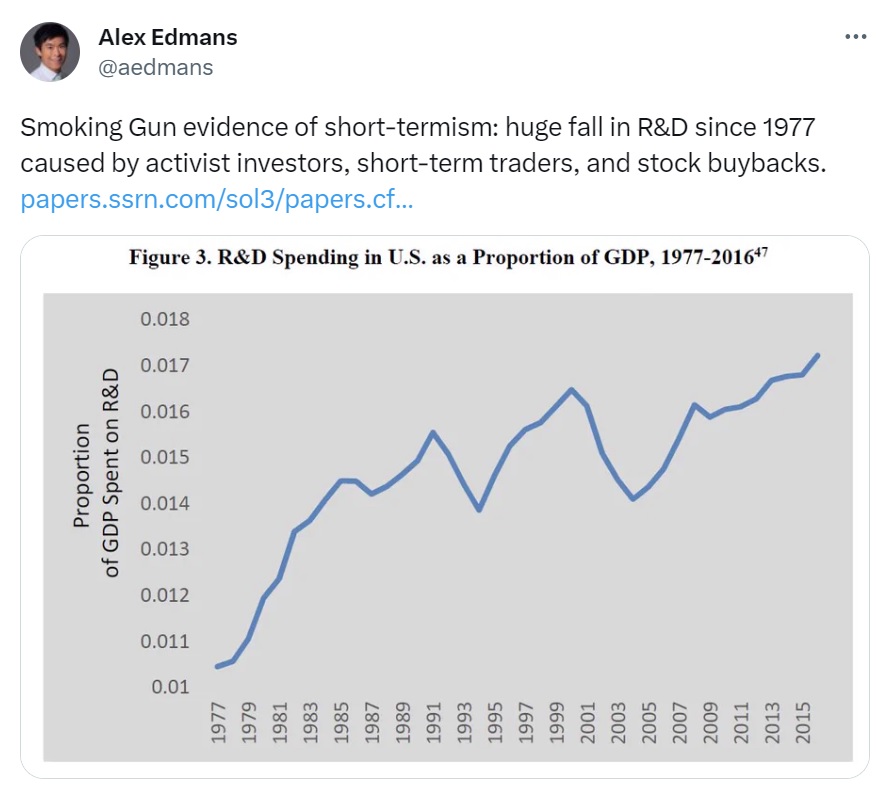
The graph was taken from Roe’s paper, and is one of his key pieces of evidence that short-termism is not a problem — research and development (R&D) spending has risen over the last 40 years, as a percentage of GDP. But my Tweet claimed the exact opposite — that there had been a ‘huge fall in R&D since 1977’ and that this was ‘smoking gun evidence of short-termism.’
While I provided a link to the paper, you didn’t even need to click on it to see that my quote was false. The graph showed, clear as day, that the line was going up. But many people retweeted and liked my post, probably because they also believed capitalism to be short-termist and latched onto anyone claiming this, even though my claim was clearly false. Here’s one of the retweets: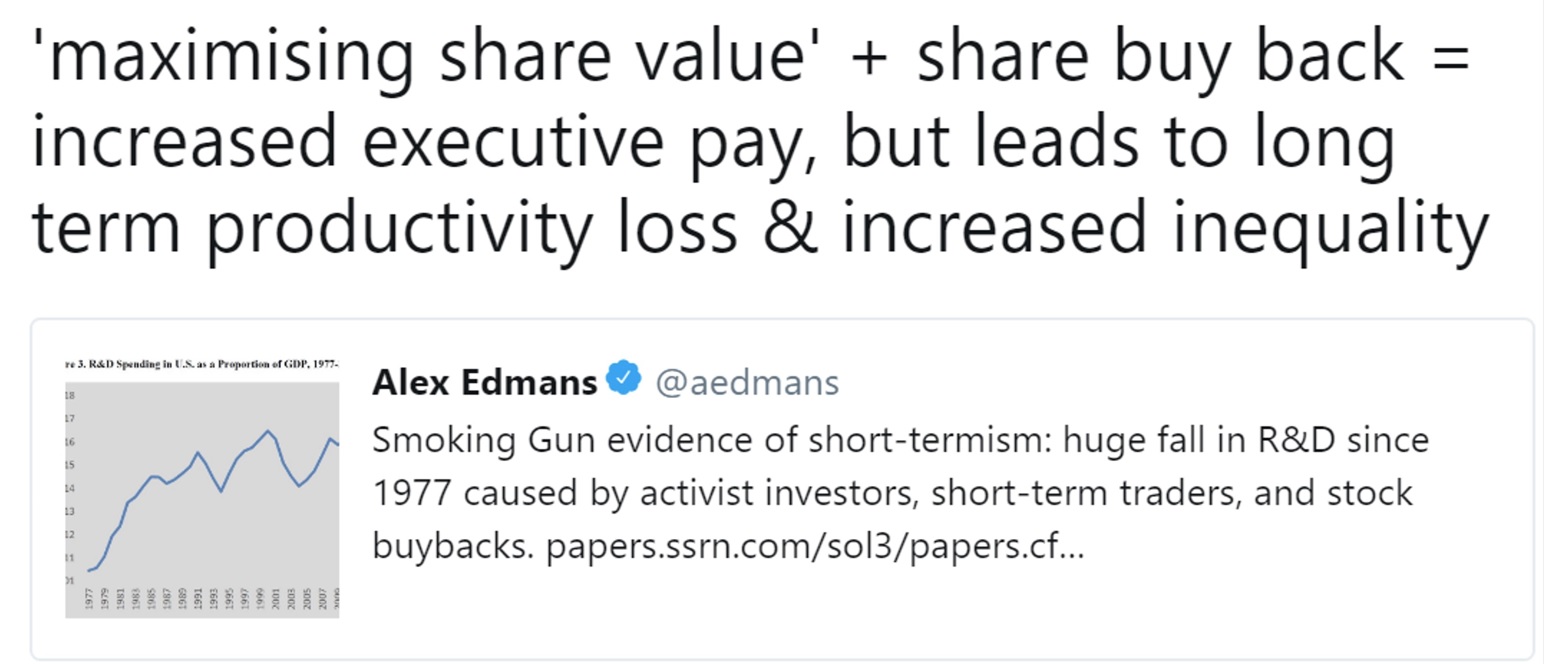
My post never mentioned ‘maximising share value’, ‘increased executive pay’, ‘long-term productivity loss’ or ‘increased inequality’, and the graph showed a rise in investment which is good for productivity. Confirmation bias causes you to see whatever you want to see — even if both words and pictures show something completely different.


